



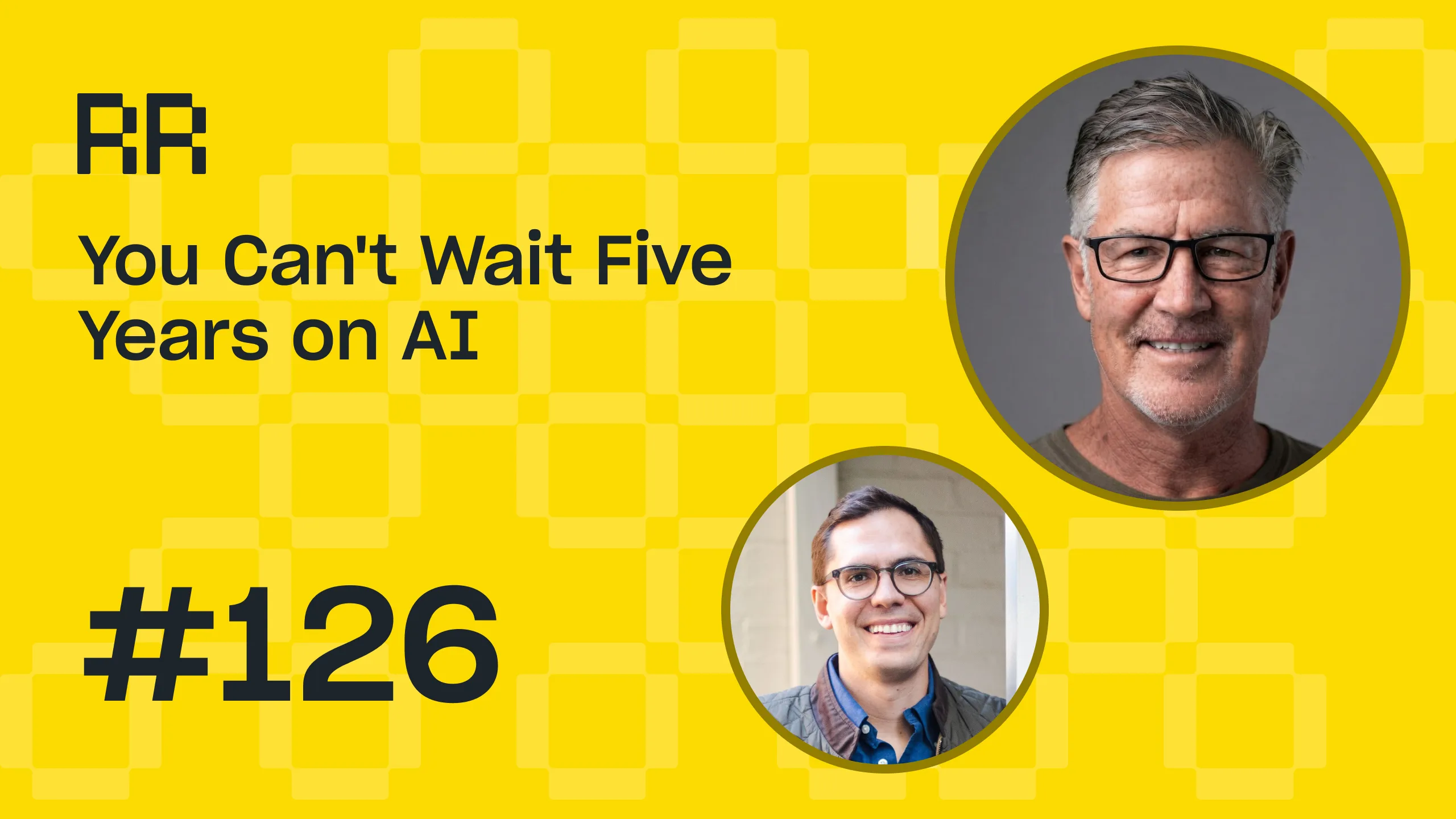
How are your customers buying today? Stephen Smith started asking that question at a forklift dealership in 1998. Answering it meant canceling the dealership’s Yellow Pages contracts and betting on the internet, and web leads grew about 10x over the next five years. Now Stephen is asking the same question about AI.
On episode 126 of The Rental Roundtable, I sat down with Stephen Smith, CEO of EquipmentFX. Stephen started at a Caterpillar dealership in Southern California in 1989, went on to run its Hyster forklift dealership, and has spent the years since 2007 helping equipment companies put better marketing, sales, and technology to work. These days that work is mostly AI.
Stephen has lived through two big technology shifts in this industry, and the lessons from the first one carry over to the one we’re in now. Here’s what I took away.
Start With How Your Customers Buy
When Stephen took over the dealership in 1998, sales were declining for reasons outside anyone’s control, including a brand change and territory issues. So Stephen asked the retiring general manager a simple question: what’s our customer acquisition strategy? The answer was that it was the salesman’s responsibility. At the time, the CRM system was reps walking out the door with AS/400 green bar reports, multicolored highlighters, and chicken scratch notes.
Not wanting to leave growth entirely in the salesmen’s hands, Stephen dug into how to build a database, what the value proposition was, how to reach customers, and how to build a website. Then Stephen canceled every Yellow Pages contract, which had been costing about $150,000 a year.
“The salesman, there was a mild revolt. They said, ‘Where are we going to get our leads?’ And I said, ‘We’re going to own this internet thing.’” Stephen Smith, CEO, EquipmentFX, (10:22)
It worked. Back then, matching a title tag to your page content could win the top spot on search, and the dealership held three to five top positions for forklift rental, sales, service, and used equipment. Contact forms filled out in their territory went from 432 in year one to 4,836 five years later. The manufacturer couldn’t keep up with the out-of-territory leads they were passing along. NACCO Industries later did a study of the dealership, “What It’s Like When It’s Right,” focused on how it used digital tools to generate leads.
The big lesson for Stephen was that lead generation is “a controllable effort, a controllable outcome.” You don’t have to wait for the phone to ring. You can decide to be the company customers find first.
Your Buyers Have Done Their Homework
So what’s the answer to Stephen’s question today? It depends on how fluent your buyer is with AI, but more of them are getting fluent fast.
“They’re going to be able to get a body of information through AI that only takes a couple of minutes... they’re going to become extremely well informed and they’re going to be able to reach out pretty much automatically to three to five different vendors and then sort through the quotes.” (14:09)
That makes the whole process faster and more competitive. I told Stephen that when we started Quipli around online renting in 2020 and 2021, that was still novel for this industry. Now the game has shifted again. Customers are asking Claude or ChatGPT where to rent a skid steer for their project and showing up already knowing what they need. Showing up in that answer takes a different strategy than having a website where people can rent online.
Stephen’s advice is to start by typing that exact question into one of the AI models and seeing what comes back. To show up, you need to create a lot of context around your company, and much of that comes from proactively answering buyers’ questions about your products, sometimes in long-form content. There’s a science to it, and not many people are doing it yet. Kalli Fowler made a similar case on episode 123: your customers’ questions are your best marketing.
Smaller Companies Can Compete on Brand Now
This is what gets Stephen most excited. You don’t need a national-sized budget to be the first local company someone thinks of.
“The brand awareness tools allow companies, small and medium-sized, to compete with the biggest companies on the planet if they’re applied correctly. And that’s the most exciting shift to me... we’ve created a democracy of tools.” (7:43)
Stephen sees CRM and LinkedIn outreach tools as especially underused in this industry. But it takes balance. Nobody wants to be on the receiving end of ads and emails that never stop, so the goal is to promote yourself without overdoing it. It also takes patience. Nothing happens overnight with leads or brand awareness; it’s a long play.
For an independent operator, that’s good news. The tools the nationals use to get found are available to you too. The difference is whether you actually apply them.
Keep a Human in the Loop
I asked Stephen whether AI is a bigger shift than the internet was. For a solo operator like Stephen, it’s a seismic shift: work that took weeks now takes minutes, much of it talked into Claude through Wispr Flow on early-morning hikes. We use Wispr Flow at Quipli too, and it’s an easy first step if you want to be faster at anything written.
For equipment dealers, though, Stephen thinks the internet may still have been the bigger change, at least for now. AI pays off when you have a defined outcome: you either get a lot of hours back, or you get a lot of leads that turn into customers. And some decisions shouldn’t be handed off.
“If you know how to apply the AI and keep the humans in the loop, don’t let machines make decisions about buying equipment that need to be specced out, scoped out, so the load center’s right and doesn’t tip over. You can’t trust an AI agent to do that.” (18:07)
Stephen also warned that good AI takes real work up front. Adding the proper context “takes a lot of human effort,” because it makes mistakes until it understands your tone, your customers, and your products. That’s what scares people off. AI can do a lot for prospecting and awareness, but when it comes to taking the order, it needs to hand off to a person.
I shared one example of where I think this goes: an after-hours voice agent that talks to customers, which rental companies have always wanted and now can have. That’s the thinking behind Quinn, our AI agent. It catches the call your team can’t get to, and your people still make the decisions that need a human.
Clean Up Your Data Before You Ask AI to Use It
One of the two products Stephen is building, Agent X², came straight out of customer complaints about messy data. It sits on top of old ERP and business systems and organizes data that’s living in silos.
“Everybody’s got messy data... People can’t really leverage AI, unfortunately, in our industry unless they have organized legacy data that an AI agent can act on.” (25:46)
I hear about this problem constantly. Rental companies want to move to newer software, but their data is spread across systems from decades ago, so they feel stuck. If that data can be pulled out and organized, the old system loses its grip, and that’s good for the operator.
Stephen’s former owner had a saying that fits: “leading edge, not bleeding edge.” A lot of these tools have been de-risked. Many companies try something, don’t see early returns, and give up. Stephen’s advice is to stick to a plan for 90 or 180 days, because that’s when the bigger changes show up. You can see more on how AI is changing day-to-day rental work in episode 118 with Dan Crowley.
Slow Down, But Don’t Wait Too Long
I close every episode by asking for the best career advice a guest has received. Stephen’s came from the dealer principal, on an airplane ride between two branch locations, at a time when Stephen saw everything as black and white and wanted every change made right now.
“Slow down, but don’t wait too long.” (32:34)
Take stock, tomorrow is okay, but keep the forward momentum. In product development, Stephen said, you get it to 90% and call it enough. I told Stephen I’d rather have the reins than the whip with our team. Telling someone to slow down is a lot easier than telling them to speed up.
Stephen’s challenge to rental leaders is to make room for that momentum.
“I challenge all the leaders out there to take some risks. Set aside some risk capital, not a lot, but have a pretty well-defined project with a champion with a defined outcome and take some risks and see what happens.” (34:12)
The timing matters. Stephen pointed out that you could wait five years on the internet, “but you can’t wait 5 years for AI.” A competitor can figure out what you’re doing in a couple of minutes and respond in a couple of hours.
So pick one known bottleneck, give it to someone curious, and decide what success looks like. If missed after-hours calls are on your list, we’d be happy to show you how Quipli handles them.